Zapytanie o materiały, konsultację techniczną lub dobór rozwiązania? Skontaktuj się z nami.


 GEOGABION
Materiały inżynieryjne dla budownictwa i infrastruktury
Geocells
Our engineering solutions
Geocells
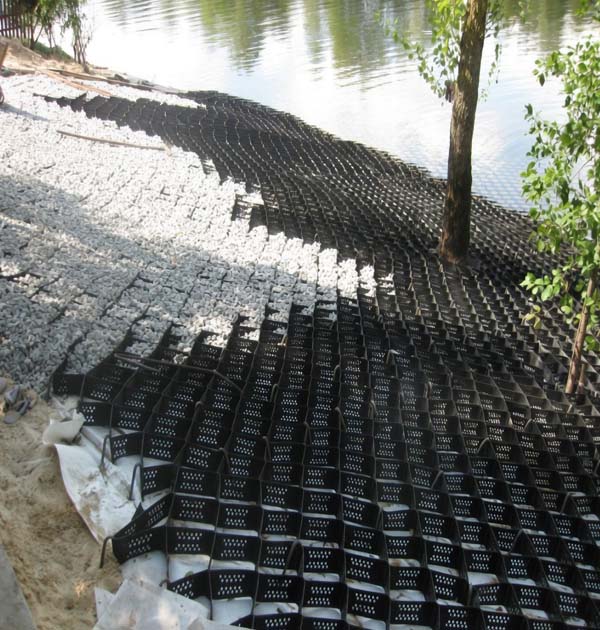
Geocells are three-dimensional cellular confinement systems used for ground stabilization, soil reinforcement and erosion control. Their interconnected cellular structure confines infill material, improves load distribution and creates a reinforced soil layer that increases the performance and durability of earth structures.
What are geocells?
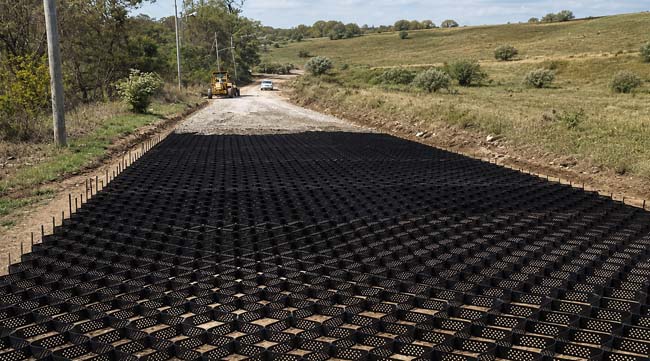
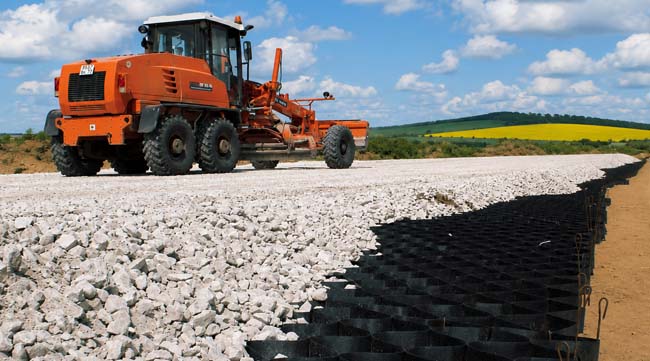
Geocells are three-dimensional geosynthetic systems manufactured from welded HDPE strips that expand into a honeycomb-like cellular structure. After installation and filling with soil, aggregate, concrete or other infill materials, the system confines the fill, increases ground stability and improves the bearing capacity of the subgrade.
The cellular confinement effect reduces lateral movement of the infill, distributes loads more efficiently and enhances the long-term performance of earth structures.
Geocells are widely used in transportation infrastructure, hydraulic engineering, industrial construction and erosion control applications.
Where are geocells used?
Geocells are commonly used for:
● road base reinforcement;
● stabilization of weak soils;
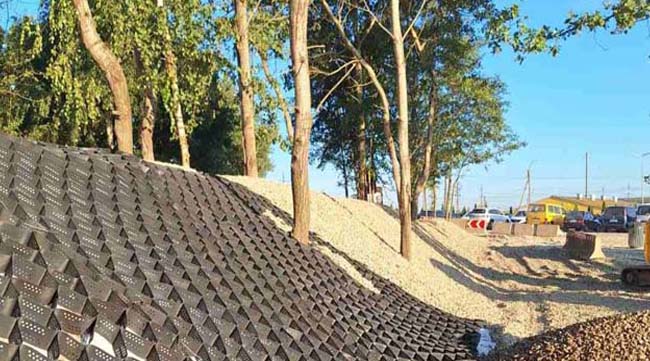
● slope stabilization;
● erosion control systems;
● flood embankments;
● working platforms;
● parking areas and access roads;
● railway infrastructure;
● hydraulic structures;
● industrial developments.
Why choose geocells?
The main advantages of cellular confinement systems include:
● increased bearing capacity of weak soils;
● confinement of soil and aggregate;
● improved load distribution;
● reduction of settlement and rutting;
● longer service life of pavements;
● enhanced apparent soil cohesion;
● use of locally available infill materials;
● reduced aggregate consumption;
● fast installation;
● suitability for both slopes and flat surfaces.
Which parameters are important when selecting geocells?
The following parameters should be considered:
● cell height;
● strip type;
● textured strips;
● perforated or non-perforated configuration;
● strip tensile strength;
● weld spacing;
● section dimensions;
● type of infill material;
● anchoring method;
● slope geometry;
● design loads;
● service conditions.
The selection of system parameters should always be based on project requirements, ground conditions and the intended application.
Technical characteristics
● material: HDPE;
● material density: 0.94 g/cm³;
● strip type: textured;
● configuration: perforated or non-perforated;
● cell height: 25, 50, 75, 100, 150, 200, 250, 300 mm;
● strip tensile strength: 13–30 kN/m;
● elongation at maximum load: 15 ± 8%.
● material density: 0.94 g/cm³;
● strip type: textured;
● configuration: perforated or non-perforated;
● cell height: 25, 50, 75, 100, 150, 200, 250, 300 mm;
● strip tensile strength: 13–30 kN/m;
● elongation at maximum load: 15 ± 8%.
Geocell selection for the project
The selection process should consider soil conditions, design loads, environmental exposure and the required service life of the structure. Cell height, weld spacing, strip type, anchoring system and infill material are selected according to the technical requirements of the project.
In infrastructure applications, geocells are frequently combined with geotextiles and geogrids to create multi-layer ground reinforcement systems with improved structural performance.
Technical parameter table
| Parameter | Typical values |
|---|---|
| Material | HDPE |
| Material density | 0.94 g/cm³ |
| Strip type | Textured |
| Configuration | Perforated / Non-perforated |
| Cell height | 25, 50, 75, 100, 150, 200, 250, 300 mm |
| Strip tensile strength | 13–30 kN/m |
| Elongation at maximum load | 15 ± 8% |
Typical geocell sections
| Cell type | Weld spacing | Typical expanded panel size | Area |
|---|---|---|---|
| Small cell | 335–370 mm | approx. 3.5 × 6.56–6.65 m | 22.97–23.28 m² |
| Medium cell | 445–550 mm | approx. 3.5 × 6.61–6.72 m | 23.13–23.52 m² |
| Large cell | 680–740 mm | approx. 3.5 × 6.56–6.78 m | 22.95–23.72 m² |
Technical notes
● Geocells should be selected together with the appropriate infill material and anchoring system.
● Cell height should correspond to design loads and slope geometry.
● Strip type and weld spacing directly influence the structural performance of the system.
● In infrastructure projects, geocells are commonly combined with geotextiles and geogrids to improve ground reinforcement efficiency.
● The final system design should consider soil conditions, hydraulic factors and the required service life.
● Cell height should correspond to design loads and slope geometry.
● Strip type and weld spacing directly influence the structural performance of the system.
● In infrastructure projects, geocells are commonly combined with geotextiles and geogrids to improve ground reinforcement efficiency.
● The final system design should consider soil conditions, hydraulic factors and the required service life.
Related materials
● Parking grids
● Gabions and mattresses made from double-twisted mesh
● Culverts and retention tanks
● Erosion control mats
● Gabions and mattresses made from double-twisted mesh
● Culverts and retention tanks
● Erosion control mats
Technical parameter table
| Parameter | Typical values |
|---|---|
| Material | HDPE |
| Material density | 0.94 g/cm³ |
| Strip type | Textured |
| Configuration | Perforated / Non-perforated |
| Cell height | 25, 50, 75, 100, 150, 200, 250, 300 mm |
| Strip tensile strength | 13–30 kN/m |
| Elongation at maximum load | 15 ± 8% |
Typical geocell sections
| Cell type | Weld spacing | Typical expanded panel size | Area |
|---|---|---|---|
| Small cell | 335–370 mm | approx. 3.5 × 6.56–6.65 m | 22.97–23.28 m² |
| Medium cell | 445–550 mm | approx. 3.5 × 6.61–6.72 m | 23.13–23.52 m² |
| Large cell | 680–740 mm | approx. 3.5 × 6.56–6.78 m | 22.95–23.72 m² |
Need help selecting the right geocell system?
Contact our engineering team for technical advice, product documentation and a solution tailored to your project requirements.

Skontaktuj się z naszym zespołem, aby uzyskać ofertę, dokumentację techniczną lub wsparcie przy realizacji projektu.
Skontaktuj się z nami
Materiały
- Gabiony i materace z siatki o podwójnym skręcie
- Gabiony zgrzewane, siatki i ogrodzenia
- Siatki pierścieniowe i heksagonalne do systemów ochronnych
- Geokrata komórkowa
- Przepusty i zbiorniki retencyjne
- Pale śrubowe i wiaty fotowoltaiczne
- Kratka parkingowa
- Elementy montażowe do gabionów
- Geomata przeciwerozyjna
- Geowłóknina
- Obrzeża trawnikowe
Kontakt
- Blosson Sp.z o.o., ul. Inflancka, 29, 61-132 Poznan, Poland
- office@geogabion.com
- +48 786 330 441


© 2026 Wszelkie prawa zastrzeżone. Stworzone przez Studio 3S
Regulamin | Polityka prywatności